
Garage Door Maintenance & Tune-Up
Balance test, hardware torque, lubrication and a full safety-system check.
View serviceA door frozen to the concrete is rarely broken. It is stuck, and the fastest way to break it is also the fastest way to turn a stuck door into a repair bill.
Stop using the opener after the first failed attempt. Disconnect it with the manual release. Chip and sweep the snow and ice away from the outside of the threshold, then pour warm, not boiling, water along the seal line and work along the bottom edge with a plastic scraper. Try lifting by hand once the bond releases. If the door still will not move, or if it moved and now sits crooked, leave it and book a repair rather than forcing it.
In a city that records 156.5 centimetres of snowfall in a season and crosses the freezing point 66.4 days a year, a garage door frozen to its threshold is a routine January event rather than a fault. What happens is simple: meltwater collects along the line where the bottom seal meets the concrete, the temperature drops overnight, and the rubber freezes to the slab. In the morning the opener tries to pull the door up against an ice bond that can be surprisingly strong. Sometimes the bond gives way. Sometimes the opener instead tears the seal off, bends the bottom section, strips its own gear set or pulls a bracket out of the top section. The difference between those outcomes is usually whether the homeowner pressed the button a second and third time. Freeing a frozen door is mostly patience and warm water, and preventing it is mostly drainage and seal condition.
Start at the top. The early checks are the most common causes and need no tools.
One failed attempt is information; three are damage. If the opener strained and the door did not move, switch the opener off at the wall or unplug it before doing anything else. Repeated attempts against a frozen door are how gear sets strip, top sections crack around the arm bracket and seals tear off along the bottom.
What it means: An opener that strained without moving the door has already told you the door is held, not powered wrongly.
Shovel and sweep snow away from the full width of the door, then chip the ice ridge that has formed against the bottom edge, working from outside in. A plastic scraper or a wooden implement is safe against the door skin; a metal chisel or a spade edge is not. Clear the photo eye brackets while you are there.
What it means: Much of what feels like a frozen door is simply a compacted ridge of snow and ice against the outside face.
Pour warm water along the line where the seal meets the concrete, across the whole width, and give it a minute. Warm rather than boiling: boiling water on cold concrete risks cracking it, and it refreezes into a worse problem. Then run a plastic scraper along the seal to break any remaining bond, and squeegee the water away from the door.
What it means: If the seal releases and lifts free of the slab, the fault was the ice bond and nothing else.
With the opener still disconnected, lift the door by hand steadily and evenly. If it comes up smoothly, prop it open, dry the threshold and the seal, and reconnect the opener. If it resists in one spot or lifts on one side only, put it back down and stop there.
What it means: Smooth manual travel means you are done; uneven or one-sided lifting means something mechanical needs attention.
Look at the bottom seal for tears, the bottom section for bowing, both cables for slack and the top section for cracking around the opener bracket. Then reconnect the opener, test its travel and confirm that both the photo eye reverse and the contact reverse still work.
What it means: A torn seal, a bowed section or slack cable means the freeze has already cost you a part.
The temptation in the cold is to use heat and force, and both cause damage. Never use an open flame, a propane torch or a heat gun on a garage door: the skin, the insulation and the seal are all vulnerable and the fire risk in a garage is real. Never use boiling water on frozen concrete. Do not chip at the seal with metal tools, and do not keep running the opener in the hope the bond will break, since the part that gives way may be the top section or the operator's gears. If the door has lifted crooked or a cable has gone slack, leave it down and keep the opening clear.
Hamilton's numbers explain why this happens so often here. The airport climate station records a January daily mean of about minus five degrees, 40.8 centimetres of snowfall in January alone and 156.5 centimetres across the season, with 66.4 freeze-thaw days a year on the 1976 to 2005 baseline. That is a lot of melting followed by refreezing right at the door line. Escarpment-side and Mountain-edge streets add grade, so a driveway that falls toward the garage delivers meltwater straight to the threshold, and unheated pre-1945 detached garages in the lower city never warm up enough to dry it out.
Fill out the form and we'll confirm your appointment by email.
These guides are written for Hamilton homes. If the fix is beyond a homeowner check, we work everywhere inside this area.
Map data © Google. Pin shows the service area, not a walk-in location — all work is done at your home.

A real callout, not stock imagery.
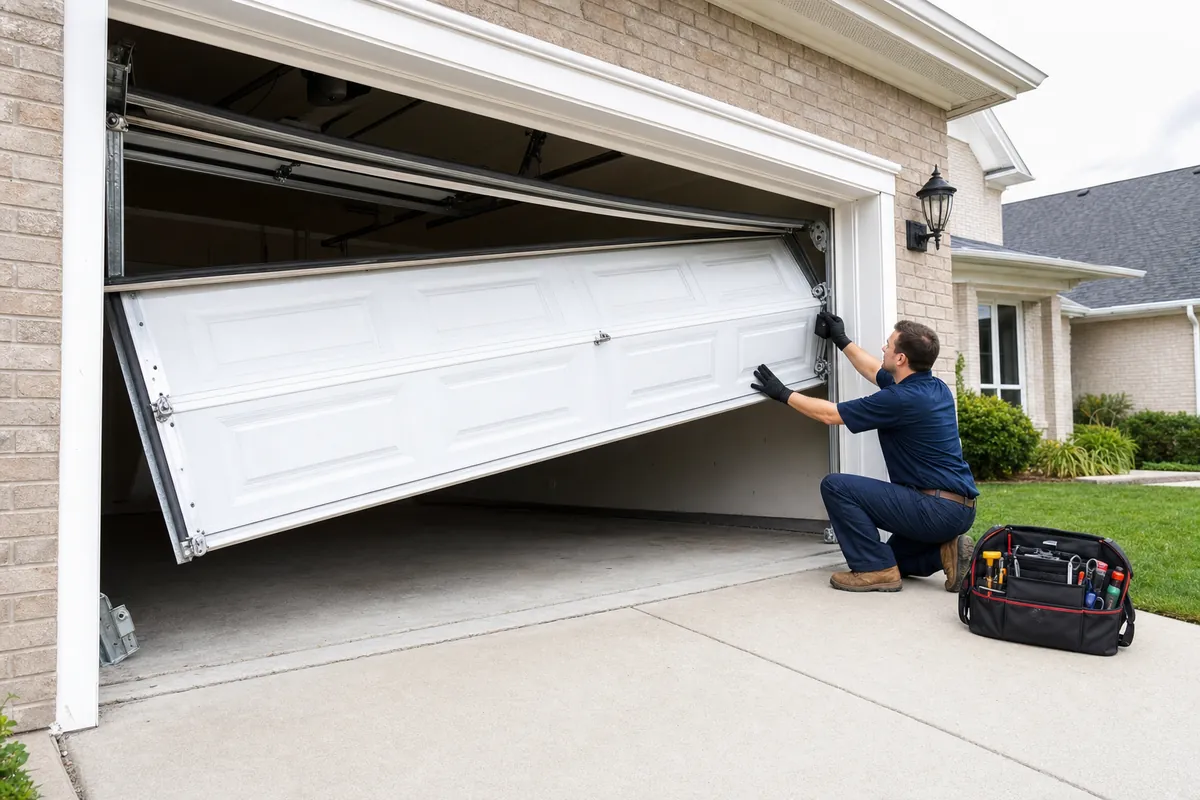
A sectional door pulled off its tracks, taken down and supported on site so it could be checked and re-hung safely — photographed on the job.