
Garage Door Spring Replacement
Broken torsion and extension springs swapped for correctly matched sets.
View detailsFrayed, slack or unwound lift cables renewed and rewound evenly on both drums.

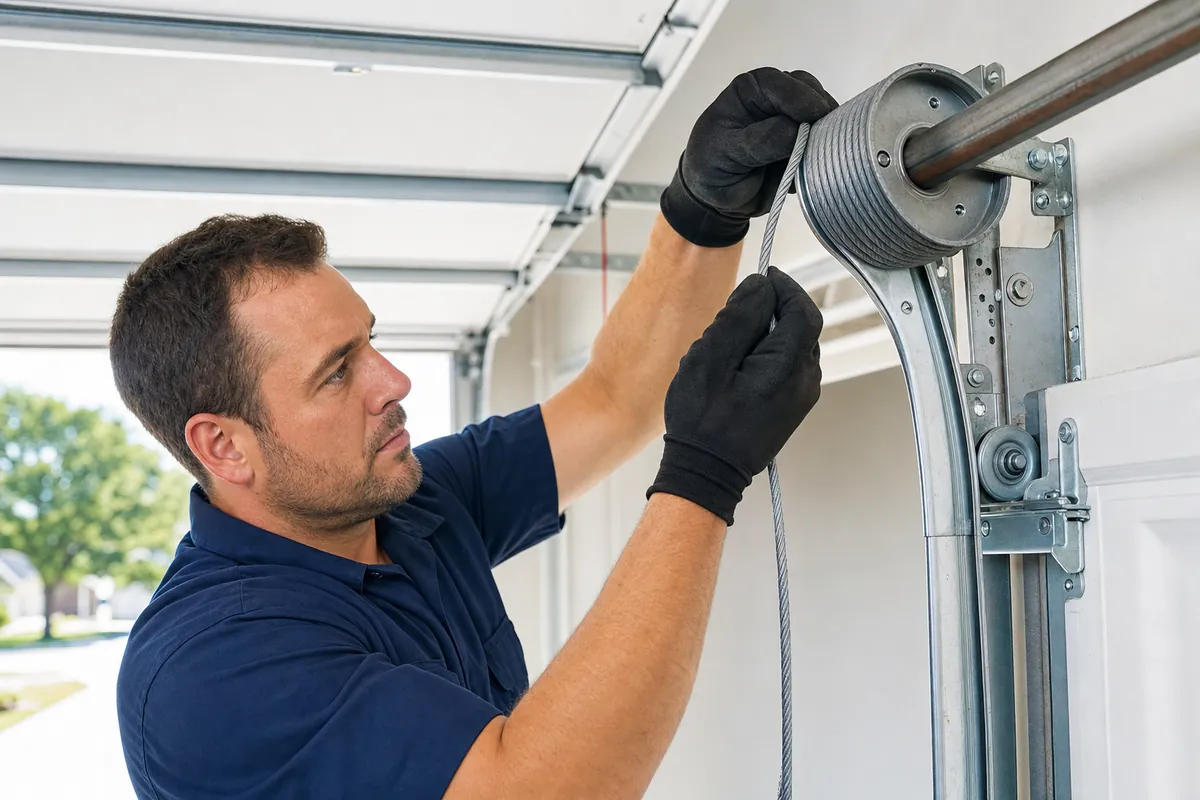
Lift cables are the quiet part of the system. They run from the bottom brackets up to grooved drums on the torsion shaft, and they translate the spring's stored energy into lifting the door evenly on both sides. When a cable frays, slips a wrap or snaps, the door immediately stops travelling square, and a door out of square is on its way out of the track. Cable work is fast when caught early and expensive when it is not.
Galvanised lift cables commonly last ten to fifteen years in a dry garage and notably less in a damp, salted one. They rarely fail without warning, though: fraying, kinking and rust staining at the bottom fitting appear first, which is why an annual look at the lowest few centimetres of both cables is worth more than any other inspection you can do yourself. Replacing cables in pairs, keeping the threshold draining away from the door and keeping the counterbalance correct are what get you to the top of that range.
Our troubleshooting guides walk the diagnostic checks in order so you can confirm the fault before booking.
The lowest few centimetres of cable sit where water, snowmelt and road salt collect against the threshold. That is where cables rust from the inside of the strand outward, so a cable can look acceptable at eye level and be nearly gone at the fitting. This is the single most common cable failure in Hamilton's older east-end and lakeside garages.
When a spring breaks, the load it was carrying arrives somewhere else in an instant. Cables are frequently kinked, stretched or thrown off their drums by that event, which is why cables are always inspected as part of a spring repair rather than treated as a separate item.
A drum that has slipped on the shaft, a bent bottom bracket or a vertical track that has shifted will make a cable run at an angle. Running at an angle abrades the strand against the drum flange, and abrasion at one spot is how a cable that is otherwise sound fails early.
If the door closes onto a bin, a snowbank or a vehicle bumper, one cable goes slack while the drum keeps turning. The cable then rewinds badly or jumps its groove. On short lower-city driveways and narrow laneway aprons, obstructions near the threshold are a routine hazard rather than a rare one.
Road salt is the local villain here. Hamilton receives around 156.5 centimetres of snowfall in a season at the airport station, and the salt that comes with clearing it arrives in the garage on tyres and boots and ends up in the meltwater at the threshold. Lower-city and Stoney Creek lakeside garages, many of them unheated and built before 1961, give that mixture the longest contact time with the cable ends. Rinsing the bottom of the door and the threshold after the salt season is a small habit with a measurable payoff.
Cables are under spring tension whenever the door is not fully supported, and the bottom bracket they attach to is one of the most dangerous fittings on the door. Never loosen a bottom bracket, never try to re-seat a cable on a drum by hand, and do not run the opener to see whether a slack cable will sort itself out. If a cable has snapped, keep the door down and out of use. A door hanging on one cable can twist out of the track without warning.
A door with a failed cable is not properly supported. It is secured in the track and the opener is isolated so it cannot pull against it. Only then is the bottom bracket area approached, since that bracket is under cable tension and is a known injury point.
Replacing a cable without establishing the cause guarantees a repeat. The drums, shaft, bearings, bottom brackets, track alignment and spring condition are all inspected, and the failure pattern on the old cable usually says which of them is responsible.
Cables are replaced in pairs so both sides have the same condition and length, seated properly in the drum grooves and wound so that tension is equal at rest. Even tension is what keeps the bottom section level throughout the travel.
The door is cycled by hand and then under power, watching the bottom section for level travel and listening for contact at the drums. Limits and force are reset if needed, and the photo eyes and contact reverse are tested before the visit finishes.
Broken torsion and extension springs swapped for correctly matched sets.
View details
Seized rollers, bent rails and derailed sections corrected and re-squared.
View details
Fast attention for doors hanging crooked, jammed part-way, or stuck wide open.
View detailsFill out the form and we'll confirm your appointment by email.
Garage Door Cable Repair is available across every Hamilton neighbourhood inside the area below.
Map data © Google. Pin shows the service area, not a walk-in location — all work is done at your home.
A real callout, not stock imagery.
A sectional door pulled off its tracks, taken down and supported on site so it could be checked and re-hung safely — photographed on the job.