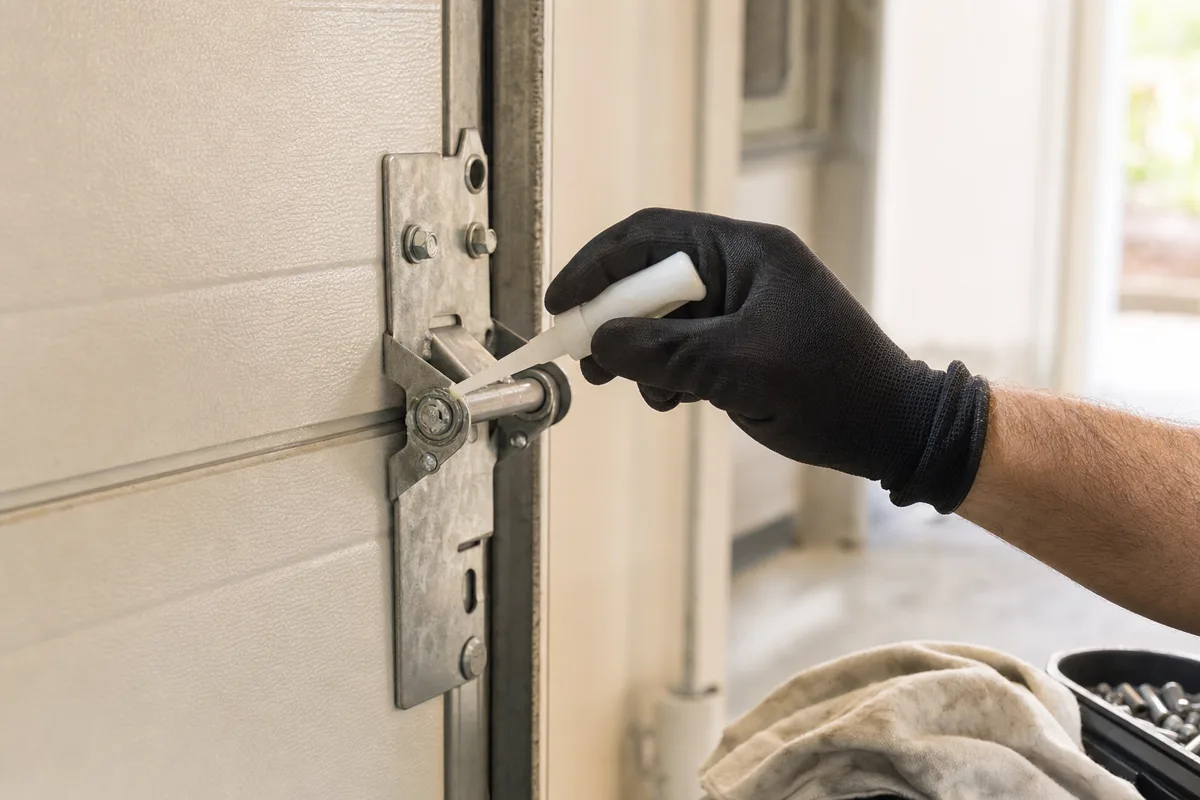

Garage Door Roller & Track Repair
Seized rollers, bent rails and derailed sections corrected and re-squared.
View serviceGarage doors do not get louder for no reason. Each family of noise points at a different part of the system, and one of them means stop using the door today.
Grinding or rumbling through the whole travel usually means rollers and tracks. Squealing usually means the system is dry and needs proper garage door lubricant on hinge pins, roller stems, bearings and the spring. Rattling means fasteners have worked loose. A repeated slap at one point means a specific damaged component. A single loud bang, especially if the door will not lift afterwards, means a spring or cable has failed: stop using the door, keep the opener off and book a repair.
Noise is the most useful diagnostic a garage door gives you, because different faults sound genuinely different. Grinding and rumbling that follow the door up and down almost always come from the guide path: worn rollers with seized bearings, grit in the tracks, or a track that has drifted out of alignment. Squealing and chirping usually mean dry hinge pins, dry roller stems or a dry spring, all of which are lubrication problems. Rattling and clattering point at loose fasteners and worn hinges. A repetitive slap or click at the same point in the travel points at a chain, a trolley or a single damaged roller. And a single loud bang with no warning is a different category altogether, because that is what a torsion spring or a cable sounds like when it fails. Sorting the noise into one of those groups tells you whether you are booking maintenance or stopping immediately.
Start at the top. The early checks are the most common causes and need no tools.
Pull the manual release and move the door by hand through its full travel, listening. If the noise is still there without the opener running, it comes from the door: rollers, hinges, track, cables or spring. If the noise disappears, the opener and its drive are the place to look.
What it means: Noise present by hand means a door fault; noise only under power means the operator or its drive.
Note whether the sound is continuous, happens only near the floor, only near the top, or at one specific height every cycle. A noise at one point is a single damaged part, typically a roller, a hinge or a dent in the track. A continuous noise is a system-wide condition such as dryness or grit.
What it means: A noise at one repeatable point localises the fault to one component you can usually see.
Look at each roller as the door moves slowly. A roller that skids rather than turns has a seized bearing. Check for flat spots, wobble in the stem and debris packed in the bottom of the vertical track. Clean the inside of the track with a cloth rather than oiling it.
What it means: Skidding or wobbling rollers explain most grinding, and replacing them as a set is the usual fix.
With the door closed, check hinge screws, track lag bolts, bracket fixings and the opener's header and ceiling mountings for looseness. Hamilton's repeated freeze-thaw cycling moves timber framing, and loose fixings both rattle and let the door run out of alignment.
What it means: Loose fasteners are a genuine cause of noise and are among the easiest things to put right.
Look at the coil above the door for a visible gap, separated halves, heavy rust or coils that have shifted along the shaft. Also look at both cables for slack or fraying. This is a look-only check: nothing about spring hardware should be adjusted, loosened or lubricated into place by hand.
What it means: A gap in the coil or a slack cable means the door should be taken out of service immediately.
One noise is not a maintenance item. A single loud bang, often described as sounding like a gunshot in the garage, is usually a torsion spring fracturing, and afterwards the door has no counterbalance. Do not try to lift it by hand and do not run the opener, which will strain against the full weight and can strip its gears or tear its mounting out of the ceiling. Equally, do not lubricate or adjust anything in the spring or bottom bracket area yourself: those parts hold enough stored energy to cause serious injury even when the door is sitting still.
Two local conditions make Hamilton doors noisy. The first is winter grit: with 156.5 centimetres of seasonal snowfall at the airport station, the sand and salt used on roads and driveways ends up in the bottom of the vertical tracks, where it grinds between roller and steel. The second is the freeze-thaw cycle, 66.4 days a year on the 1976 to 2005 baseline, which moves timber framing and loosens the fixings holding tracks and opener mountings. In the pre-1945 lower city, where unheated detached rear garages are common, both effects are stronger because the structure never warms up.
Fill out the form and we'll confirm your appointment by email.
These guides are written for Hamilton homes. If the fix is beyond a homeowner check, we work everywhere inside this area.
Map data © Google. Pin shows the service area, not a walk-in location — all work is done at your home.

A real callout, not stock imagery.
A sectional door pulled off its tracks, taken down and supported on site so it could be checked and re-hung safely — photographed on the job.
