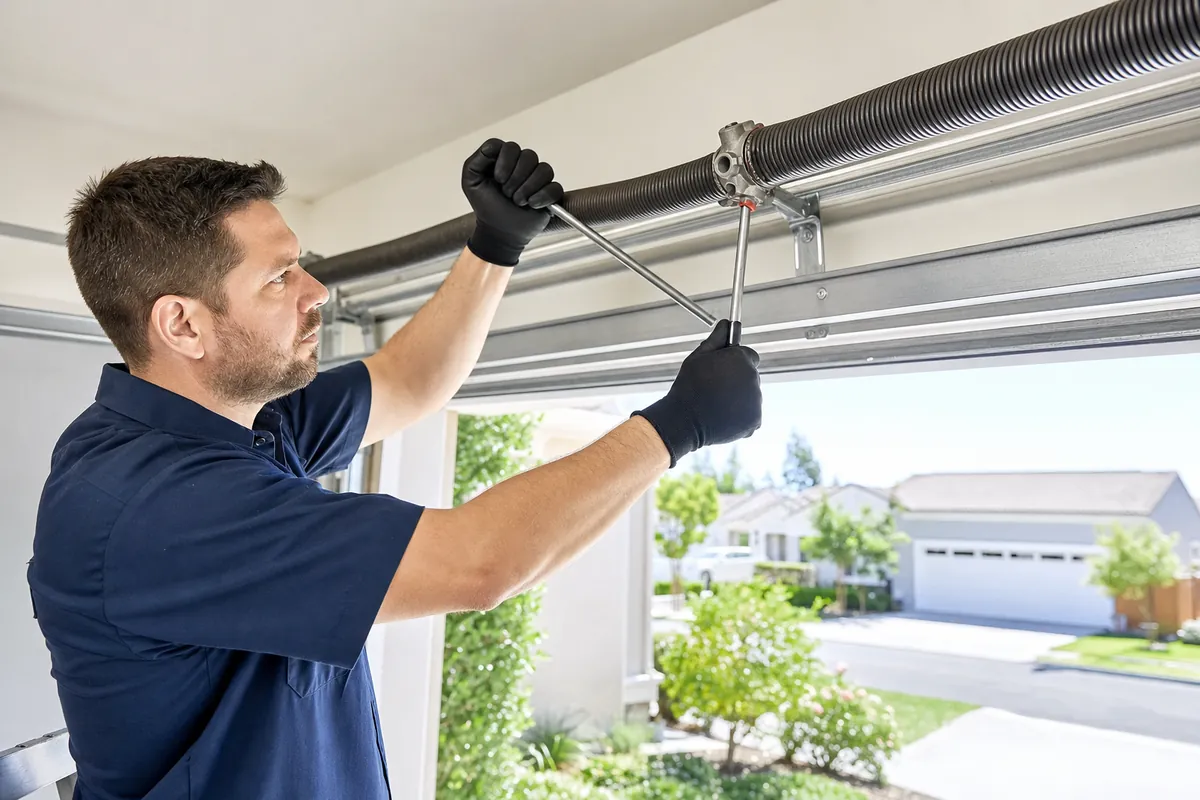

Garage Door Spring Replacement
Broken torsion and extension springs swapped for correctly matched sets.
View detailsTension, bearings and shaft hardware set right on springs that are still intact.

Spring work is the part of a garage door that most rewards being done carefully. The counterbalance is what makes a hundred-kilogram door feel light, and when it drifts out of adjustment the whole assembly starts wearing itself out quietly. Repair here means diagnosing why the balance is wrong, correcting tension, renewing worn components and confirming the result by hand rather than by feel through the opener.
Expect a standard spring to give somewhere near ten thousand cycles and a high-cycle spring two to three times that, with the real figure depending on sizing, lubrication and how damp the garage is. Four openings a day is around 1,460 cycles a year, so the arithmetic is easy to do for your own household. Keeping the coil lightly lubricated, the bearings greased and the door balanced gets you toward the top of the range instead of the bottom, and it makes the eventual failure a scheduled job rather than a surprise.
Our troubleshooting guides walk the diagnostic checks in order so you can confirm the fault before booking.
Springs are rated in cycles, not years. A standard residential spring is often rated near 10,000 cycles, which a busy household reaches in well under a decade. As the steel fatigues it loses tension gradually, so the door feels heavier long before anything visibly breaks.
Rust does not just look bad on a spring; it changes how the coil moves against itself and creates the stress concentration where a fracture will eventually start. Unheated garages and damp lower-city or lakeside conditions accelerate it, and a dry, rust-flecked spring is usually within sight of the end of its life.
If a door was replaced without recalculating the counterbalance, or if an insulated door went in on the previous door's springs, the balance was wrong from day one. This shows up as a door that has always felt heavy and an opener that has always worked hard.
Hamilton's January daily mean is around minus five degrees, and cold stiffens lubricant and contracts steel. A spring that is dry, or bearings that have never been greased, add friction the counterbalance was not sized to overcome, which reads as a balance problem when it is partly a maintenance one.
Hamilton has 66.4 freeze-thaw days a year on the 1976 to 2005 baseline, which means the temperature crosses zero dozens of times each winter rather than once. Every crossing moves moisture into and out of the garage, and unheated garages in the pre-1945 lower city cycle hardest of all. That is why springs here often show surface corrosion before they show fatigue, and why a spring inspected in autumn gives a far more useful answer than one inspected after it has failed in January.
A wound torsion spring holds enough energy to break bones, and it releases that energy in an instant if a winding bar slips or the wrong fastener is loosened. This is the one part of a garage door that should not be adjusted with hand tools and hope. Never loosen a winding cone, a bottom bracket or a drum set screw while the spring is under tension. If the door has already dropped hard once, treat everything holding it as suspect until it has been inspected.
The opener is disconnected and the door is moved by hand. A correctly balanced door lifts with modest effort and stays roughly where it is left near the middle of its travel. Where it wants to run up or crash down tells you which way the tension is out.
Coil condition, cone and shaft alignment, bearing plates, centre bearing, cable drums and cable condition are checked together. A spring problem is often accompanied by a worn drum or a frayed cable, and fixing one without the other simply moves the failure.
Where the spring is sound, tension is adjusted with proper winding bars and the balance is retested. Where the steel is fatigued, cracked or corroded, adjustment is the wrong answer and replacement is recommended with the reason given plainly.
The door is checked by hand again, then the opener is reconnected and its travel limits and force settings are set to the corrected balance. Photo eyes and the contact reverse are tested last so the safety systems match the way the door now moves.
Broken torsion and extension springs swapped for correctly matched sets.
View details
Fast attention for doors hanging crooked, jammed part-way, or stuck wide open.
View details
Balance test, hardware torque, lubrication and a full safety-system check.
View detailsFill out the form and we'll confirm your appointment by email.
Garage Door Spring Repair is available across every Hamilton neighbourhood inside the area below.
Map data © Google. Pin shows the service area, not a walk-in location — all work is done at your home.
A real callout, not stock imagery.
A sectional door pulled off its tracks, taken down and supported on site so it could be checked and re-hung safely — photographed on the job.