
Garage Door Spring Replacement
Broken torsion and extension springs swapped for correctly matched sets.
View detailsFast attention for doors hanging crooked, jammed part-way, or stuck wide open.

A garage door that has failed mid-cycle is not a cosmetic problem. It leaves a vehicle trapped, a house open, or a heavy panel held up by hardware that has already proved it can let go. Emergency work is about making the opening safe and predictable first, then repairing it properly rather than getting the door moving and hoping. In Hamilton that often also means reaching a rear-lane garage in the lower city or a driveway on a steep escarpment street in winter.
An emergency repair should restore the door to a condition that lasts, not just to one that moves. Replacement springs, cables and rollers have their own cycle ratings, and a door that is properly balanced afterwards puts far less strain on every other part. Where a failure was caused by corrosion or by framing that has moved, the underlying condition is worth addressing at the same visit, because otherwise the same part fails again within a season or two. Anything that cannot be fixed permanently on the day should be described as temporary out loud.
Work through the symptom first — some of these turn out to need no technician at all.
Springs carry the weight of a residential garage door; the opener only overcomes friction and starts it moving. When a spring fractures, that weight transfers instantly to the opener, the cables and whatever is holding the door at that moment. The door may refuse to lift, rise a few centimetres and stop, or drop faster than it should. Until the counterbalance is dealt with, nothing about the door's weight can be assumed.
Lift cables run from the bottom brackets to grooved drums on the torsion shaft. If one fails or unwinds, the door lifts on one side only and jams diagonally in the tracks. In Hamilton's older east-end and lower-city garages the failure point is usually the bottom few centimetres, where meltwater and road salt sit against the fitting through a long winter.
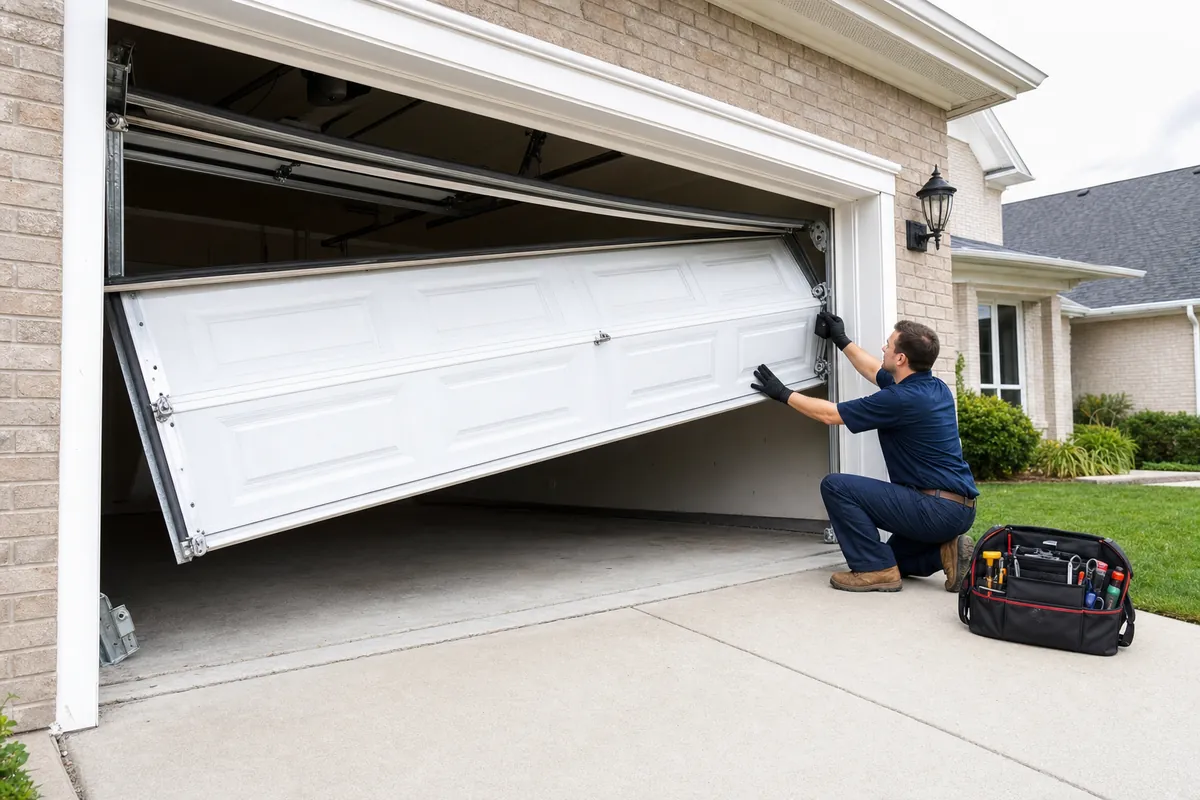
A seized roller, a bent track, a struck door or a cable failure can walk a section out of its guide path. Once one roller is out, the door is no longer supported the way it was designed to be, and running the opener again usually turns a small derailment into bent sections and torn hinges.
Vehicle contact, a failed header fixing or a rotted jamb can put the whole assembly out of alignment. Narrow lower-city approaches and short laneway aprons leave little room for manoeuvring, and a glancing contact at low speed is enough to bend a bottom section or shift a vertical track.
Two Hamilton conditions shape emergency calls. The first is snow: the airport climate station records 156.5 centimetres of snowfall in a season and 40.8 centimetres in January alone, so a door that fails in the cold is often frozen to the slab as well as mechanically broken. The second is the escarpment. More than twenty access routes climb between the lower city and the Mountain, and lower-city garages are frequently reached from one of the 818 laneways in the City's inventory, which are only three to four metres wide. Describing the approach when you book saves time on arrival.
Torsion springs store a great deal of energy, and they store it whether the door is up or down. Winding cones, cables under load and bottom brackets are the parts that injure people, and they do it without warning. If a spring has broken, do not try to force the door up by hand or with the opener, do not stand in the opening, and do not remove a bottom bracket. Keep children and vehicles clear of the doorway and use another entrance until the door has been secured.
The first question is whether the door can move on its own. Its position, the state of both cables and the condition of the bottom brackets decide what happens next. Where it is safe to do so, the opener is isolated so it cannot pull against a door that is heavy, twisted or unsupported, and the door is secured before anyone works underneath it.
The obvious symptom is not always the cause. A door jammed part-open may have a broken spring, a slipped cable, a seized roller or all three, because one failure loads the others. Springs, cables, drums, rollers, tracks, hinges, brackets and the header are checked as one system before any part is quoted.
Where the parts are on the van and the structure is sound, the repair is completed on the visit. Where a section has to be ordered or framing needs attention, the door is left in a safe, secured state with the options described plainly, including what happens if it is left as it is.
A repaired door is tested by hand with the opener disconnected: it should lift smoothly and hold near the halfway point. Then the opener is reconnected, limits and force are set, and the photo eyes and contact reverse are tested so the door stops and reverses as it should.
Broken torsion and extension springs swapped for correctly matched sets.
View details
Frayed, slack or unwound lift cables renewed and rewound evenly on both drums.
View details
Seized rollers, bent rails and derailed sections corrected and re-squared.
View detailsFill out the form and we'll confirm your appointment by email.
Emergency Garage Door Repair is available across every Hamilton neighbourhood inside the area below.
Map data © Google. Pin shows the service area, not a walk-in location — all work is done at your home.