
Garage Door Opener Repair
Diagnosis for openers that hum, stall, reverse or ignore the wall button.
View detailsOperators sized to the door, fitted to a balanced system, safety reverse tested.

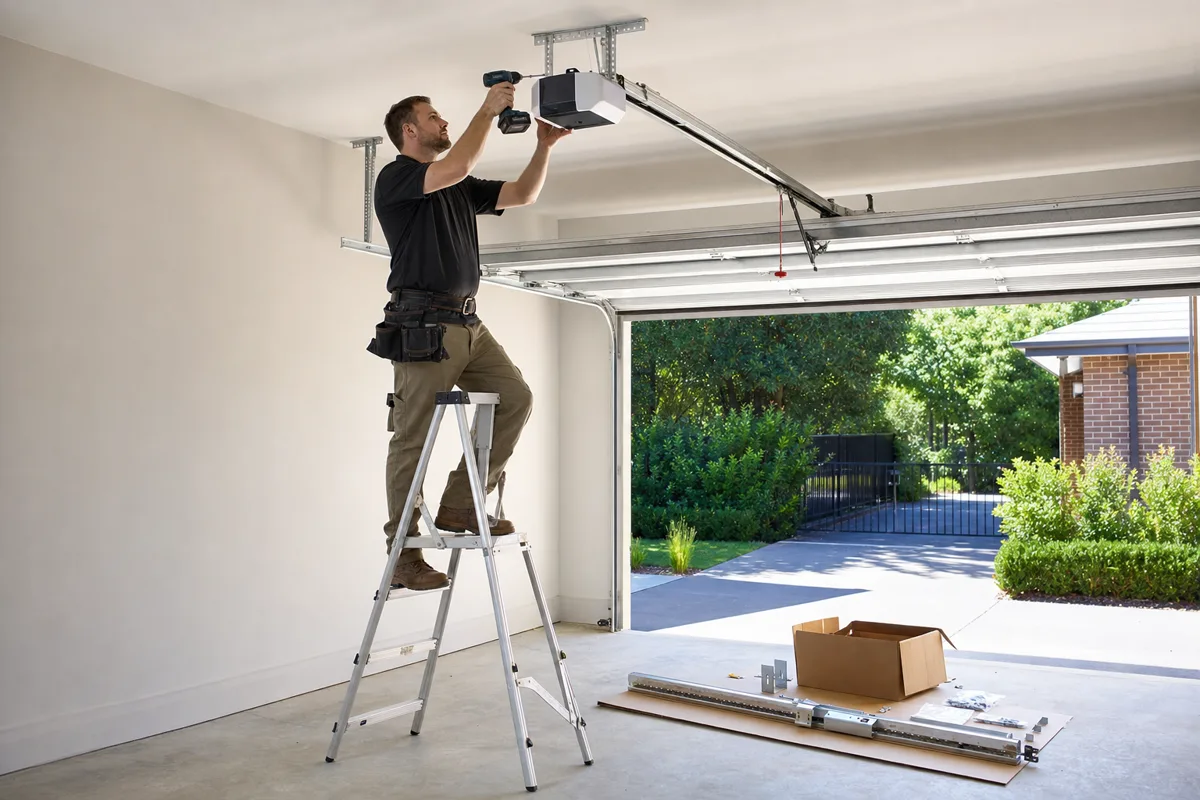
Fitting an opener is mostly preparation. The door has to be balanced and running freely before an operator goes on it, the mounting has to be into structure that can take the load, and the safety devices have to be positioned and tested to the manufacturer's instructions. Choosing between chain, belt and wall-mount drive is the easy part; making the installation last is about what happens before the unit comes out of the box.
A well-installed opener on a balanced door should give ten to fifteen years, and the installation quality is a bigger factor in that than the price of the unit. Solid mounting, correct force and limit settings, protected sensor wiring and a door that moves freely are what keep a gear set intact. Batteries in backup units typically need replacing every few years, and it is worth noting the date so a dead backup is not discovered during the outage it was bought for.
Work through the symptom first — some of these turn out to need no technician at all.
Door width, height, weight and construction decide what the operator needs to be. A wide insulated double door on a Mountain or Ancaster home asks more of a drive than a light single door on a lower-city detached garage, and the rail length has to suit the door's height of travel.
Belt drives are the quiet choice and are worth it where a bedroom or living space adjoins or sits above the garage, which is common in townhouses and tuck-under garages. Chain drives are robust and economical for detached garages. Wall-mount units free up ceiling space where headroom is tight.
The rail needs clear length behind the opening and the head unit needs solid anchorage. Older Hamilton garages, especially pre-1945 detached structures and tuck-under bays, frequently need blocking or angle iron added because the existing framing does not line up with the bracket.
A dedicated receptacle within reach of the head unit, in the position the manufacturer specifies, is part of a proper installation rather than an afterthought. Battery backup earns its place on rural and semi-rural properties such as Binbrook and outer Glanbrook, where an outage can last hours.
Hamilton's building eras change the installation rather than the product. In the pre-1945 lower city, where detached rear garages reached from the laneway network are common, the work is often in the mounting and the electrical supply rather than the opener itself. In the 1960s and 1970s Mountain subdivisions, ceilings need checking for proper blocking. In townhouse-heavy areas such as Templemead, where a third of dwellings are row houses, a quiet belt drive matters because the garage shares walls and often sits beneath a bedroom.
An automatic opener is a powerful machine attached to a heavy moving object, and its safety features are not optional extras. External photoelectric sensors and a working contact reverse are the two things that protect children, pets and vehicles, and they must be tested at handover and monthly afterwards. Wall controls belong out of reach of small children and clear of the door's path. Never leave a new installation with the force settings turned up to mask a mechanical problem in the door.
The door is balance-tested with no opener attached, and springs, cables, rollers, hinges and track alignment are put right before an operator is considered. Fitting a new opener to a door that binds simply transfers the problem to a new gear set.
The header bracket is fixed into solid structure above the opening and the rear hanger is fixed to the ceiling framing, with blocking or steel added where the existing structure is not adequate. Hangers are kept short and braced so the rail cannot sway in use.
The head unit, rail, trolley and door arm are fitted, then the photo eyes are mounted at the height the manufacturer specifies and their wiring is run and secured properly rather than draped. The wall control and any keypad are installed where they can be reached without standing under the door.
Travel limits are set so the door seals without crushing, force is set no higher than needed, and both the contact reverse and the photo eye reverse are demonstrated. Remotes, keypad and any app are set up, and the manual release is shown and explained before the visit ends.
Diagnosis for openers that hum, stall, reverse or ignore the wall button.
View details
Balance test, hardware torque, lubrication and a full safety-system check.
View details
Replacement doors measured to the real opening, headroom and side room.
View detailsFill out the form and we'll confirm your appointment by email.
Garage Door Opener Installation is available across every Hamilton neighbourhood inside the area below.
Map data © Google. Pin shows the service area, not a walk-in location — all work is done at your home.

A real callout, not stock imagery.
A sectional door pulled off its tracks, taken down and supported on site so it could be checked and re-hung safely — photographed on the job.