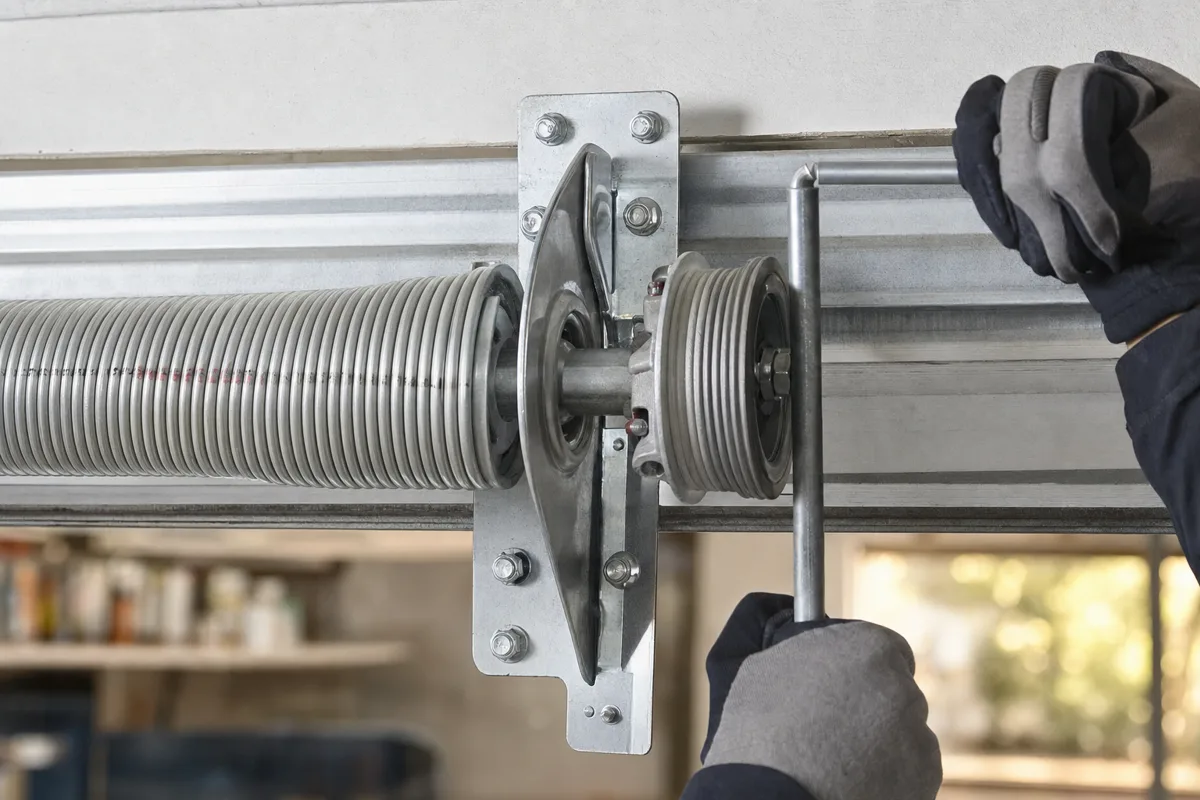

Garage Door Spring Replacement
Broken torsion and extension springs swapped for correctly matched sets.
View serviceSprings, not the opener, carry the weight of a garage door. When one fails the whole system changes character, and the signs are easy to read once you know them.
Look at the coil above the door: a two to five centimetre gap, or two separated halves, means the spring has fractured. Other signs are a bang from the garage followed by a door that will not lift, a door that is very heavy by hand, an opener that strains or trips, and a door that will not stay put when raised halfway. If any of these apply, keep the door down, keep the opener switched off, keep everyone out of the opening and book a repair rather than experimenting.
The counterbalance is the single most important part of a garage door and the part homeowners think about least. A torsion spring, mounted on a shaft above the opening, stores energy as the door comes down and gives it back as the door goes up, which is why a door weighing well over a hundred kilograms can be lifted with one hand. The opener only overcomes friction and gets the door moving. That means a failed spring does not simply make the door harder to open; it removes the entire mechanism that made the door safe to move at all. The signs are distinctive: a loud bang, a visible gap in the coil, a door that suddenly feels enormously heavy, an opener that hums or lifts a few centimetres and stops, or a door that drops the last stretch of travel faster than the rest. Recognising them early is what turns an emergency into a scheduled repair.
Start at the top. The early checks are the most common causes and need no tools.
Stand back with a torch and look at the spring or springs on the shaft above the door. A healthy torsion spring is a continuous tight coil. A broken one shows a clear gap, usually a couple of centimetres or more, or two separate halves that have shifted apart along the shaft. Look, do not touch.
What it means: A visible gap in the coil is conclusive: the spring has failed and the door should not be used.
An opener working against a failed counterbalance behaves distinctively: it hums without moving the door, lifts it a few centimetres and stops, trips its overload, or makes a labouring noise it never used to. Note this before changing any settings, and switch the unit off once you have.
What it means: An opener straining or stalling on a door that used to move easily points straight at the counterbalance.
If the door is already down and you have reason to think a spring is gone, do not lift it to check. If the door is up and you need to know, disconnect the opener and try raising it only a few centimetres. A balanced door lifts with modest effort; a door with no counterbalance feels immovable.
What it means: Extreme weight by hand confirms a counterbalance failure, and that is the point to stop testing.
On a door light enough to move safely, raise it to about waist height with the opener disconnected and let go gently while standing clear. A correctly balanced door stays roughly where it is left. Drifting down or running up means the tension is wrong even if nothing has visibly broken.
What it means: A door that will not hold position has a counterbalance problem, whether or not the spring has fractured yet.
A spring failure loads everything downstream of it. Look for cables hanging slack or kinked, a bottom section sitting crooked, a roller out of the track and cracking around the opener arm bracket. Mention what you see when you book, because it changes what parts are needed.
What it means: Slack cables or a crooked door mean the failure has already spread beyond the spring itself.
This is the one repair that genuinely injures people who attempt it. A wound torsion spring holds a great deal of energy and releases it instantly if a winding bar slips or the wrong fastener is loosened, and the bottom brackets at each end of the door are under cable tension whenever the door is not fully supported. Do not loosen a winding cone, a drum set screw or a bottom bracket. Do not substitute screwdrivers for winding bars. Do not lift a door with a broken spring by hand, and do not run the opener to try. Keep the door down, the opener off and the opening clear.
Spring life is measured in cycles rather than years, so Hamilton's housing pattern predicts where failures cluster. In the 1990s and 2000s subdivisions of Waterdown, the Meadowlands, Sheldon and Binbrook, original builder springs on doors used several times a day are reaching the end of their rated lives now. In the pre-1945 lower city, corrosion does the work instead: unheated detached garages, 66.4 freeze-thaw days a year and salt tracked in over 156.5 centimetres of seasonal snowfall mean the coil often rusts to failure well before its cycle rating is used up.
Fill out the form and we'll confirm your appointment by email.
These guides are written for Hamilton homes. If the fix is beyond a homeowner check, we work everywhere inside this area.
Map data © Google. Pin shows the service area, not a walk-in location — all work is done at your home.

A real callout, not stock imagery.
A sectional door pulled off its tracks, taken down and supported on site so it could be checked and re-hung safely — photographed on the job.