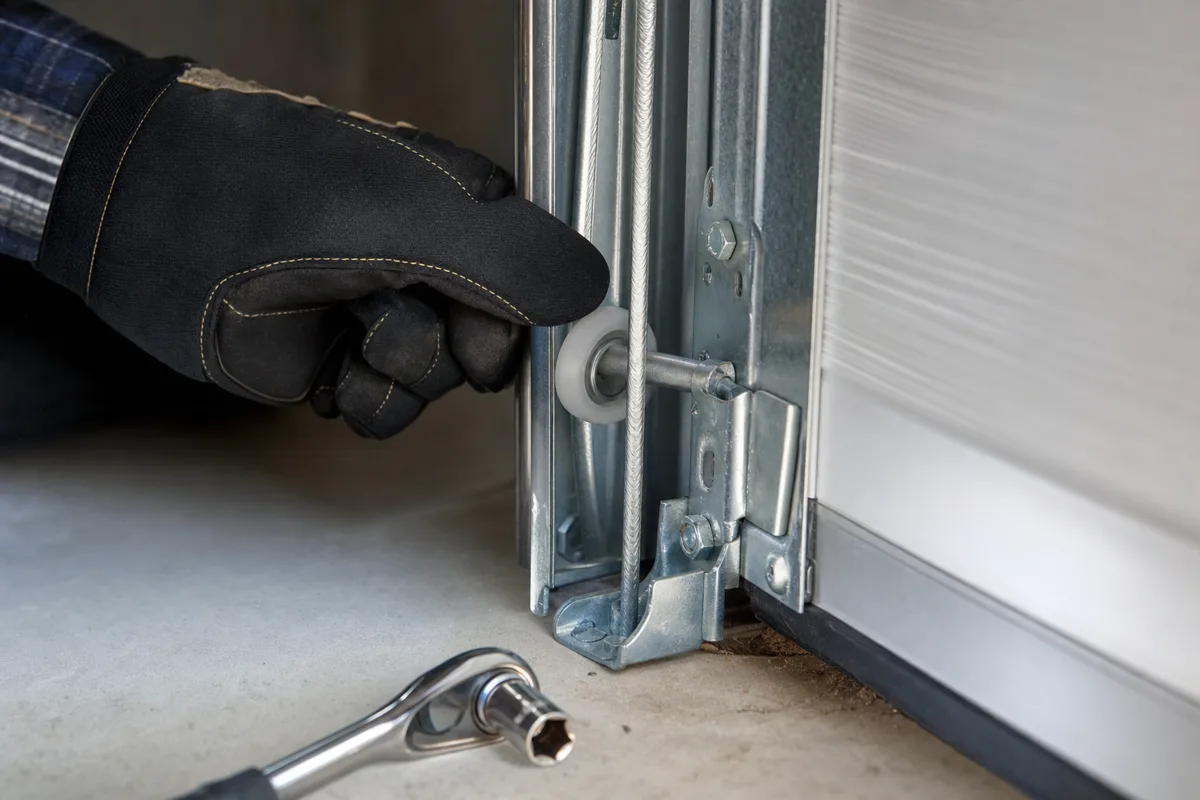

Garage Door Roller & Track Repair
Seized rollers, bent rails and derailed sections corrected and re-squared.
View serviceA door off its track is no longer supported the way it was designed to be. Every further attempt to move it turns a repair into a replacement.
Stop using the opener immediately and switch it off at the wall. Do not try to lift the door by hand or push the rollers back in. Keep vehicles and people out of the opening, and if the door is partly open leave it where it is rather than manoeuvring it. Note what you can see, whether a cable is slack, a track is bent, a roller is out or a section is bowed, and book a repair. Re-seating a door requires supporting it and managing spring tension.
A sectional garage door is guided by rollers running in steel tracks, and the whole assembly depends on every roller staying in its channel. When one comes out, the door loses part of its support, twists in the opening and starts loading hinges, sections and cables in directions they were never designed for. This is one of the few garage door faults that gets dramatically worse with each attempt to operate it, because the opener has enough force to bend sections and tear hinges out of steel. The usual causes are a seized roller, a bent or knocked track, a cable failure that let one side drop, an impact from a vehicle, or a door that closed onto an obstruction such as a bin or a snowbank. Identifying the door as off track is easy; the important part is stopping there.
Start at the top. The early checks are the most common causes and need no tools.
Look along both vertical tracks. A door off track shows a roller sitting outside its channel, a visible gap between a section and the track, a door leaning out of the opening at one point, or a section that has twisted. It will also usually have stopped part way rather than at either limit.
What it means: A roller out of its channel or a section leaning out of the opening confirms it: stop using the door.
Unplug the opener or switch it off at the wall so nobody in the household presses a button to see whether it still works. If the door is part-open and the opener is still connected, leave it connected, because it may be part of what is currently holding the door.
What it means: Removing the power is the single most useful thing you can do before help arrives.
Check both cables for slack or fraying, look for a bent or dented length of track, look for a roller that is seized or has lost its stem, and look at the coil above the door for a gap. Also look for evidence of an impact at the bottom of the door or an obstruction at the threshold.
What it means: A slack cable or a gap in the spring coil means the derailment is a symptom of a bigger failure.
Keep vehicles out from under the door and keep children and pets out of the garage. If the door is open and the garage must be left, use another entrance rather than trying to close it. Do not clamp, prop or wedge a twisted door in a way that puts you under it.
What it means: The goal until a technician arrives is that nobody is in the door's path, not that the door is closed.
Say whether the door is open, closed or part-open, whether a cable is slack, whether a section looks bent, whether a vehicle is trapped, and how the garage is reached. On a lower-city laneway garage or a steep escarpment driveway that last detail genuinely affects what gets brought to the visit.
What it means: An accurate description means the right parts and equipment arrive the first time.
A derailed door is unsupported, often still under cable and spring tension, and capable of dropping or twisting further without warning. Do not stand or park under it. Do not pull, lever or hammer a roller back into its track, and do not run the opener to see whether the door will re-seat itself; the usual result is bent sections, torn hinges, a damaged operator or an injury. Above all, do not touch the bottom brackets or any spring hardware, because those are the fittings holding the load that is currently misdirected.
Short approaches make impact damage common in Hamilton. In the pre-1945 lower city, detached rear garages are often reached from laneways that the City's own inventory describes as three to four metres wide, and there are 818 of them totalling about 100 kilometres, with roughly a third in Ward 3 alone. Manoeuvring in that space leaves little margin, and low-speed contact with a vertical track or a bottom section is a routine way for a door to end up off track. Winter adds the other route: a door closing onto packed snow goes slack on one cable and jumps the drum.
Fill out the form and we'll confirm your appointment by email.
These guides are written for Hamilton homes. If the fix is beyond a homeowner check, we work everywhere inside this area.
Map data © Google. Pin shows the service area, not a walk-in location — all work is done at your home.

A real callout, not stock imagery.
A sectional door pulled off its tracks, taken down and supported on site so it could be checked and re-hung safely — photographed on the job.