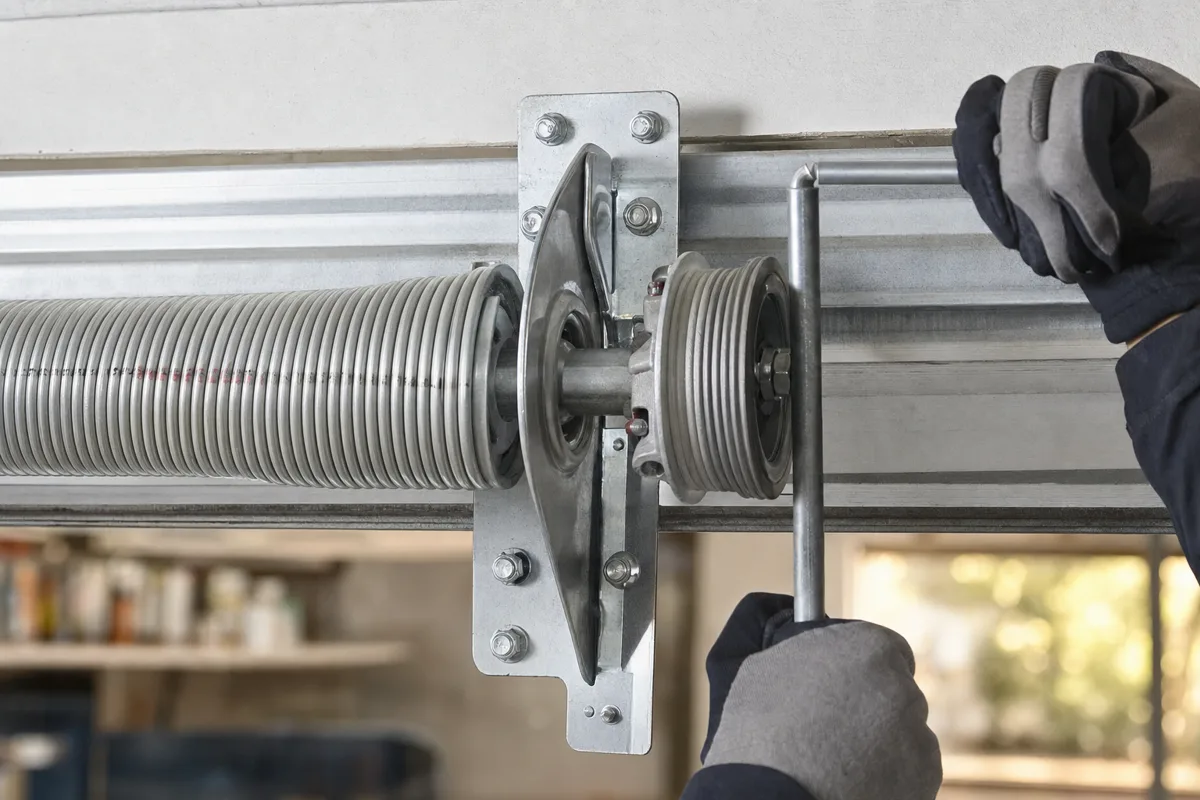

Garage Door Spring Repair
Tension, bearings and shaft hardware set right on springs that are still intact.
View detailsBroken torsion and extension springs swapped for correctly matched sets.

Replacing a garage door spring is a sizing exercise as much as a mechanical one. The new spring has to match the door's actual weight, height of travel and drum size, and the only reliable way to get there is to measure the existing components and, where needed, weigh the door. Get the sizing right and the door feels weightless and the opener barely works. Get it wrong and every other part starts paying for it.
A correctly sized standard spring gives roughly ten thousand cycles; high-cycle options are commonly rated at twenty thousand or more. Because the labour is almost identical, upgrading at replacement time is usually the better value on a door that gets heavy daily use. After fitting, three things extend the life: light lubrication of the coil once or twice a year, greased bearings, and keeping the door balanced so the spring is not fighting friction elsewhere in the system.
Work through the symptom first — some of these turn out to need no technician at all.
This is the ordinary reason and it is not a defect. Steel under repeated torsion fatigues, and every spring has a rated life. Doors installed with builder-grade springs in the 1990s and 2000s across the Mountain and the amalgamated communities are the ones reaching that point now.
An insulated steel or composite door can be considerably heavier than the uninsulated one it replaced. Carrying over the old springs leaves the counterbalance short, and the door feels heavy from the first day. This is one of the most common findings on a spring call.
Damp, unheated garages, salt carried in on vehicles and repeated freeze-thaw cycling all attack the coil. A rusted spring fails earlier than its rating suggests, which is why the coil's surface condition is part of the assessment rather than a cosmetic note.
Wire size, inside diameter, length and wind direction all have to be right. A spring that is close but not correct will balance the door approximately, which means it is fighting the door through part of every cycle and wearing out ahead of schedule.
Hamilton's housing splits neatly along the escarpment, and so does the spring work. In the pre-1945 lower city, where detached rear garages off the laneway network are common, the door is often lighter but the framing and hardware are older, so the header and bearing plates matter as much as the spring. On the Mountain and in Ancaster, Waterdown and Binbrook, wide double doors on attached garages are the norm, and there the sizing calculation and even cable tension are what decide whether the door lasts.
Spring replacement is the single most dangerous routine job on a garage door. Winding and unwinding a torsion spring requires the correct bars, correct technique and an understanding of what the door will do at every stage. Improvised tools slip, and a slipped bar becomes a projectile. Extension-spring systems need containment cables so that a failure cannot throw the spring across the garage. If your door has extension springs without containment cables, say so when you book.
Wire diameter, inside diameter, overall length and wind direction are recorded from the existing spring, and door height and drum size are confirmed. Where the door has been modified, added to or insulated, it is weighed rather than assumed, because the spring is sized to the door that is actually hanging there.
Tension is let down in a controlled way with proper winding bars, the door secured, and the old spring removed along with the cones. Cable drums, the torsion shaft, the centre bearing and the end bearing plates are inspected while everything is accessible.
The new spring is installed, wound to the calculated number of turns and the cables are set so both sides carry equal tension. Even cable tension is what keeps the door travelling square, and it is the detail that most often gets skipped on a rushed job.
The door is tested by hand: smooth travel, no drift, holding position near the middle. Then the opener's limits and force are reset to the new balance and the photo eyes and contact reverse are tested. Anything else found on the way, such as worn rollers, is reported rather than silently added.
Tension, bearings and shaft hardware set right on springs that are still intact.
View details
Fast attention for doors hanging crooked, jammed part-way, or stuck wide open.
View details
Frayed, slack or unwound lift cables renewed and rewound evenly on both drums.
View detailsFill out the form and we'll confirm your appointment by email.
Garage Door Spring Replacement is available across every Hamilton neighbourhood inside the area below.
Map data © Google. Pin shows the service area, not a walk-in location — all work is done at your home.
A real callout, not stock imagery.
A sectional door pulled off its tracks, taken down and supported on site so it could be checked and re-hung safely — photographed on the job.