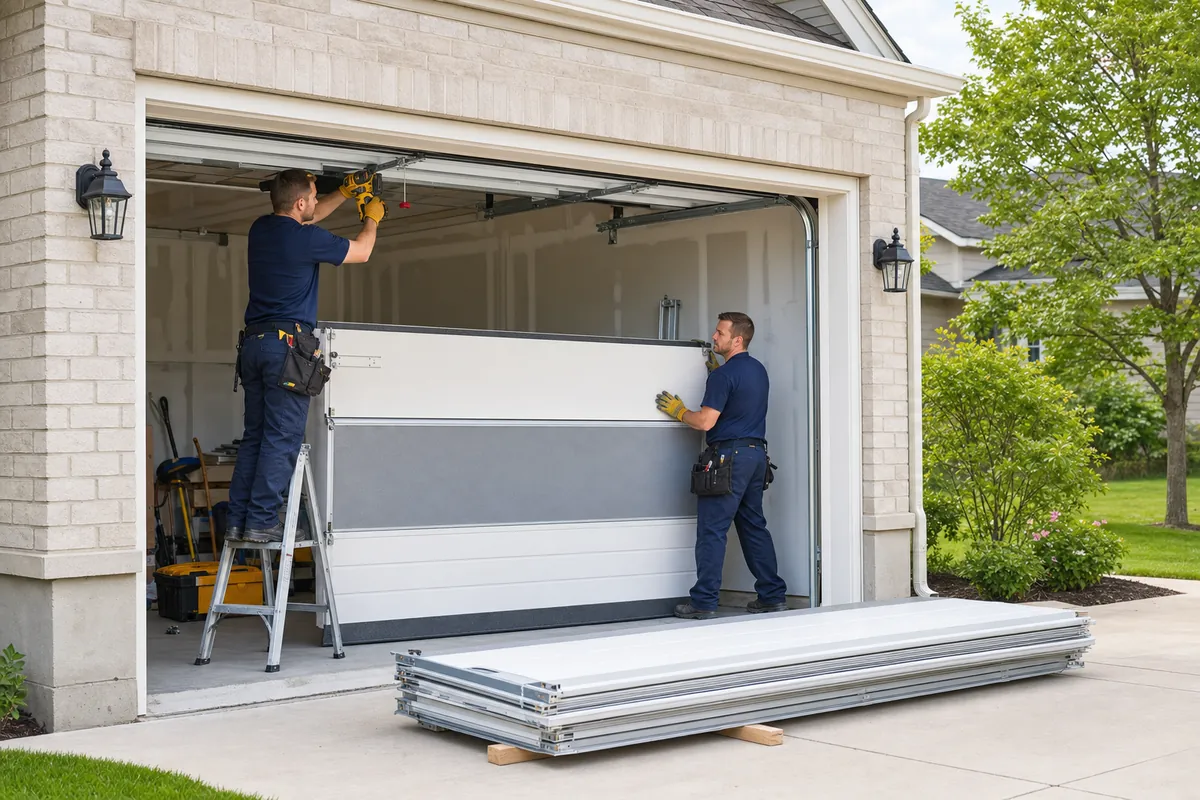

Garage Door Panel Replacement
Dented, split or rusted sections matched to the door already on the opening.
View detailsReplacement doors measured to the real opening, headroom and side room.

A new garage door is one of the largest moving parts of a house and, on most elevations, one of the largest visible surfaces. Getting it right means measuring the opening properly, choosing construction and insulation for how the garage is actually used, sizing the counterbalance to the new door's weight, and finishing with seals and framing details that keep Hamilton weather where it belongs.
A good insulated steel door, properly installed and looked after, commonly gives twenty years or more of service, with the wearing parts, springs, rollers and seals, replaced along the way. The sections themselves usually outlast everything else unless they are damaged or left to corrode at the bottom edge. Annual servicing, a threshold that drains away from the door, and washing the salt off the bottom section each spring are what separate a door that lasts twenty years from one that looks tired in eight.
Our troubleshooting guides walk the diagnostic checks in order so you can confirm the fault before booking.
Rough opening width and height, headroom above the opening, backroom along the ceiling and sideroom at each jamb all get measured. Older Hamilton garages, particularly pre-1945 detached structures, are frequently not square and not standard-sized, and low-headroom hardware exists precisely for the tight ones.
Steel gauge, single or double skin, polystyrene or polyurethane insulation and glazing options change the door's weight, stiffness, thermal performance and price. With Hamilton's January daily mean near minus five degrees, an insulated door matters most where the garage adjoins living space or is used as a workshop.
Panel profile, colour, hardware and window layout decide whether the door looks like it belongs. In Hamilton's seven Heritage Conservation Districts, exterior changes are reviewed against a district plan, so carriage-style and recessed-panel options that read traditionally while performing like modern sectionals are often the right answer.
New doors, especially insulated ones, commonly weigh more than what they replace. Springs, cables and drums are specified from the new door's weight and travel rather than carried over. Reused springs are the most common reason a brand new door feels heavy and wears out an opener early.
Hamilton asks two specific things of a new door. The first is weather: 156.5 centimetres of seasonal snowfall at the airport station, a January daily mean near minus five degrees and 66.4 freeze-thaw days a year mean seals, drainage at the threshold and insulation choice all earn their keep. The second is fit with the housing. The pre-1945 lower city has narrow openings, older framing and detached rear garages; the Mountain and the amalgamated communities have wide attached double bays; and seven heritage districts have appearance expectations.
An installation is where the door's whole safety case is set: counterbalance sized correctly, cables seated properly, header and track fixings into sound structure, and both reverse functions proven before handover. Old doors being removed are hazardous in their own right, especially extension-spring systems without containment cables. Once the new door is in, keep the photo eyes clear, test the reverse monthly and never let anyone stand in the opening while the door is moving.
The opening is measured in full, and the jambs, header and floor line are assessed for rot, movement and level. Any framing repair is identified as part of the quote rather than discovered on installation day, and the door, hardware and counterbalance are specified together.
Spring tension is released safely, the old door and hardware are removed and taken away, and the opening is prepared: jambs sound and plumb, header capable of taking the spring reaction, floor line checked so the new seal will make even contact.
Sections are set level and square from the bottom up, tracks are aligned plumb and level with correct back pitch, and the torsion assembly is fitted and wound to the calculated turns with cables set to equal tension on both drums.
Perimeter and bottom seals are fitted, the opener is connected or installed and its limits and force set, and the balance, photo eyes and contact reverse are all tested. The manual release, the maintenance routine and the manufacturer's warranty terms are explained before the visit ends.
Dented, split or rusted sections matched to the door already on the opening.
View details
Operators sized to the door, fitted to a balanced system, safety reverse tested.
View details
Balance test, hardware torque, lubrication and a full safety-system check.
View detailsFill out the form and we'll confirm your appointment by email.
New Garage Door Installation is available across every Hamilton neighbourhood inside the area below.
Map data © Google. Pin shows the service area, not a walk-in location — all work is done at your home.

A real callout, not stock imagery.
A sectional door pulled off its tracks, taken down and supported on site so it could be checked and re-hung safely — photographed on the job.