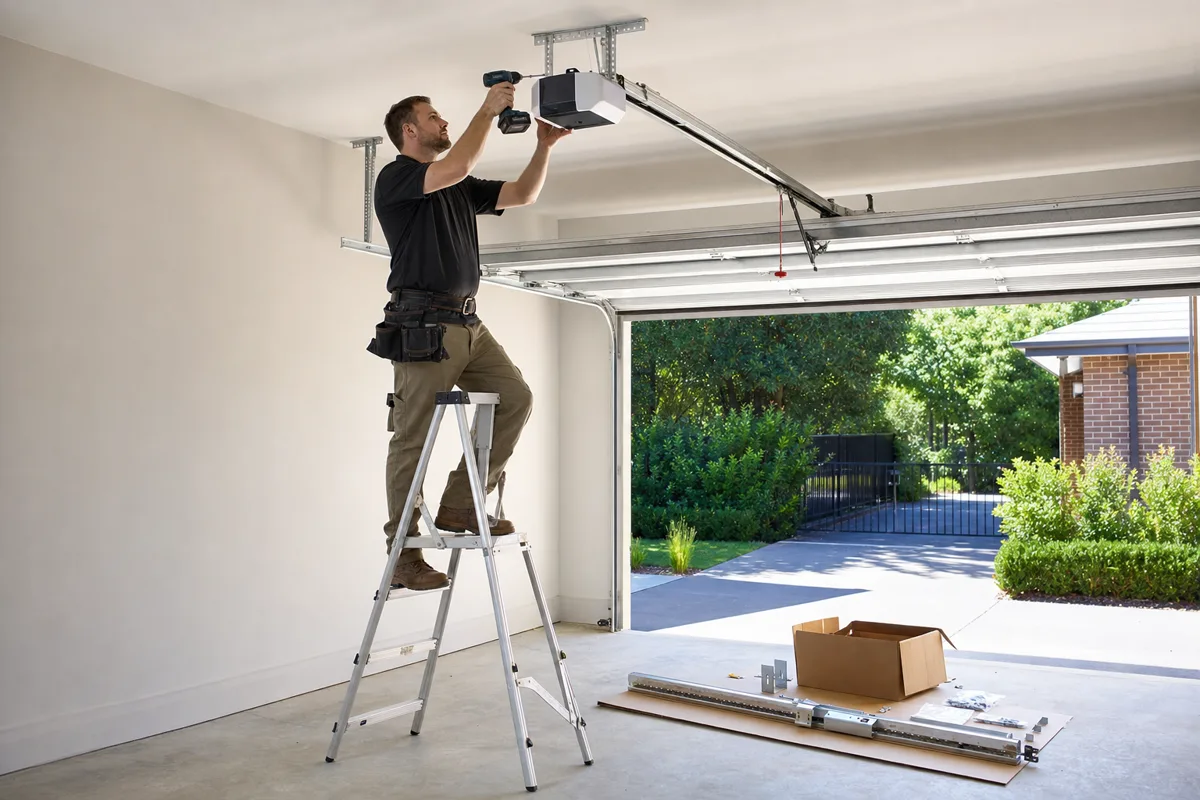

Garage Door Opener Repair
Diagnosis for openers that hum, stall, reverse or ignore the wall button.
View serviceA dead remote is usually a two-dollar problem. The trick is proving which part of the chain has failed before spending anything larger.
Press the wall control. If the door moves, the opener is fine and the fault is in the remote, the receiver or the radio path. Fit a fresh battery, checking the orientation and the contacts. Reprogram the remote to the opener using the learn button. Test a second remote or the keypad. If nothing works from any remote but the wall control still does, suspect the receiver, the antenna wire or interference from LED lighting in the garage.
Between a button press and a door moving there are four links: the remote and its battery, the radio path between remote and opener, the receiver and antenna in the head unit, and the opener's own logic and drive. A remote that has stopped working could be any of them, and the fastest diagnosis is to test the links in order from cheapest to most expensive. Start with the wall control, because if that moves the door then the opener, drive and safety circuit are all fine and the fault is confined to the radio side. Then a fresh battery, then reprogramming, then a second remote if you have one, then range and interference. In garages converted to LED lighting, interference is a genuinely common and often overlooked cause, and in an unheated Hamilton garage in January, cold batteries fail early. Very little of this needs tools.
Start at the top. The early checks are the most common causes and need no tools.
The wall button is hard-wired, so it bypasses the entire radio chain. If it operates the door normally, the motor, drive, limits and safety circuit are all working and you only have to solve a radio problem. If the wall control also fails, this is an opener problem rather than a remote problem.
What it means: A working wall control narrows the fault to the remote, the receiver or the radio path between them.
Fit a fresh battery of the correct type rather than one from a drawer, check the polarity and look at the contacts inside the remote for corrosion or a spring that has lost tension. Cold accelerates battery decline, so a remote left in a car overnight in a Hamilton January will often fail before one kept indoors.
What it means: A new battery restoring normal range is the most common resolution by a wide margin.
Find the learn or program button on the head unit, usually under the light cover, and follow the sequence in the manual: press learn, then press the remote button until the unit confirms. Power interruptions and board faults can wipe stored codes, and reprogramming costs nothing to try.
What it means: If reprogramming works, the code was lost rather than the hardware having failed.
Try another remote, the outside keypad, or the app if the unit is connected. Two remotes failing together points at the receiver, the antenna or interference rather than at the transmitters. One remote failing while another works points squarely at that remote.
What it means: All transmitters failing while the wall control works means the receiver side is the problem.
Note how close you have to be for the remote to work. A range that has shrunk to a few metres suggests interference or a damaged antenna. Switch off any LED or fluorescent lighting in the garage and retest, since cheap LED lamps and drivers are a well-known source of radio noise in this band. Check the antenna wire hangs free and undamaged.
What it means: Range that improves with the garage lights off identifies interference rather than a hardware fault.
The risks here are small but real. Do not disassemble the opener head or probe inside it without unplugging the unit first, because there is mains voltage and, in some units, a capacitor. Do not leave a remote where a child can reach it, and do not fit a keypad or wall control low enough for a child to operate while standing in the doorway. Finally, if a remote suddenly works intermittently and the door also moves without being asked, stop using the opener and have it checked, because a spontaneous operation is a safety fault rather than a nuisance.
Cold is the local factor. Hamilton's January daily mean sits near minus five degrees, and an unheated garage tracks the outside temperature closely, so coin cells and small alkaline batteries in remotes and keypads lose capacity through the winter and often fail in the coldest weeks. The pre-1945 lower city adds a second wrinkle: many homes here have a detached garage at the back of the lot, sometimes reached from one of the 818 laneways in the City's inventory, so the distance from the house to the opener is longer and marginal remote range shows up as a fault sooner than it would on an attached garage.
Fill out the form and we'll confirm your appointment by email.
These guides are written for Hamilton homes. If the fix is beyond a homeowner check, we work everywhere inside this area.
Map data © Google. Pin shows the service area, not a walk-in location — all work is done at your home.

A real callout, not stock imagery.
A sectional door pulled off its tracks, taken down and supported on site so it could be checked and re-hung safely — photographed on the job.
