
Garage Door Roller & Track Repair
Seized rollers, bent rails and derailed sections corrected and re-squared.
View detailsBalance test, hardware torque, lubrication and a full safety-system check.
Most garage door emergencies announce themselves months in advance to anyone who looks. A tune-up is that look, done deliberately: a balance test with the opener disconnected, an inspection of the parts that fail, lubrication of the parts that wear, tightening of the fasteners that loosen, and a proper test of the two safety reverses. It is the least dramatic service on the list and the one that saves the most money.
Annual servicing does not make parts immortal, but it moves them to the top of their ranges: springs toward their full cycle rating, rollers to seven to ten years or more, openers toward the fifteen-year end rather than the ten. Its larger benefit is converting surprises into scheduled work. A spring identified as tired in October is a planned visit; the same spring in January is an emergency with a car trapped behind it.
Work through the symptom first — some of these turn out to need no technician at all.
Hinge pins, roller stems, bearings and the spring itself all need a film of the right lubricant. It dries and migrates over a year, and a dry system is louder, stiffer and harder on the opener. Cold makes it worse, which is why everything feels heavier in January than it did in September.
Track lag bolts, hinge screws, bracket fixings and opener mountings all work loose as wood swells and dries. Hamilton's 66.4 freeze-thaw days a year drive that movement hard, so an annual check of the fixings is more valuable here than in a stable climate.
Rollers, hinges, cables and springs do not wear at the same rate, and a single seized roller or a slightly uneven cable will quietly load everything else. Catching that early keeps a five-minute adjustment from becoming a replacement.
Bottom and perimeter seals harden, tear and shrink, and thresholds crack. Once water can sit at the door line, freeze-thaw cycling does the rest, and a door frozen to the slab is one of the more common winter callouts in this city.
Autumn is the right time for this in Hamilton. The airport station records 156.5 centimetres of snowfall in a season and 40.8 centimetres in January alone, and the city sees 66.4 freeze-thaw days a year, so the door faces its hardest months between December and March. Servicing before the cold means seals are intact, lubrication is fresh, the threshold drains, and the counterbalance is correct before the first morning where the seal is frozen to the slab and the opener tries to pull against it.
The monthly homeowner routine is short and genuinely worth doing: break the photo eye beam while the door closes and confirm it reverses, then lay a solid object flat on the floor in the door's path and confirm the door reverses on contact. Also look at the lowest few centimetres of both cables for fraying and at the coil above the door for gaps or heavy rust. Everything involving spring tension, cables or bottom brackets belongs to a technician with the right tools.
The opener is disconnected and the door is lifted by hand. It should move smoothly and hold near the middle of its travel. This single test tells you more about the door's condition than anything else, and it is the reference point for everything that follows.
Springs, cables at both ends, drums, bearings, rollers, hinges, brackets, track alignment, the header and the sections are all examined. Anything approaching the end of its life is reported with a plain description of what happens if it is left.
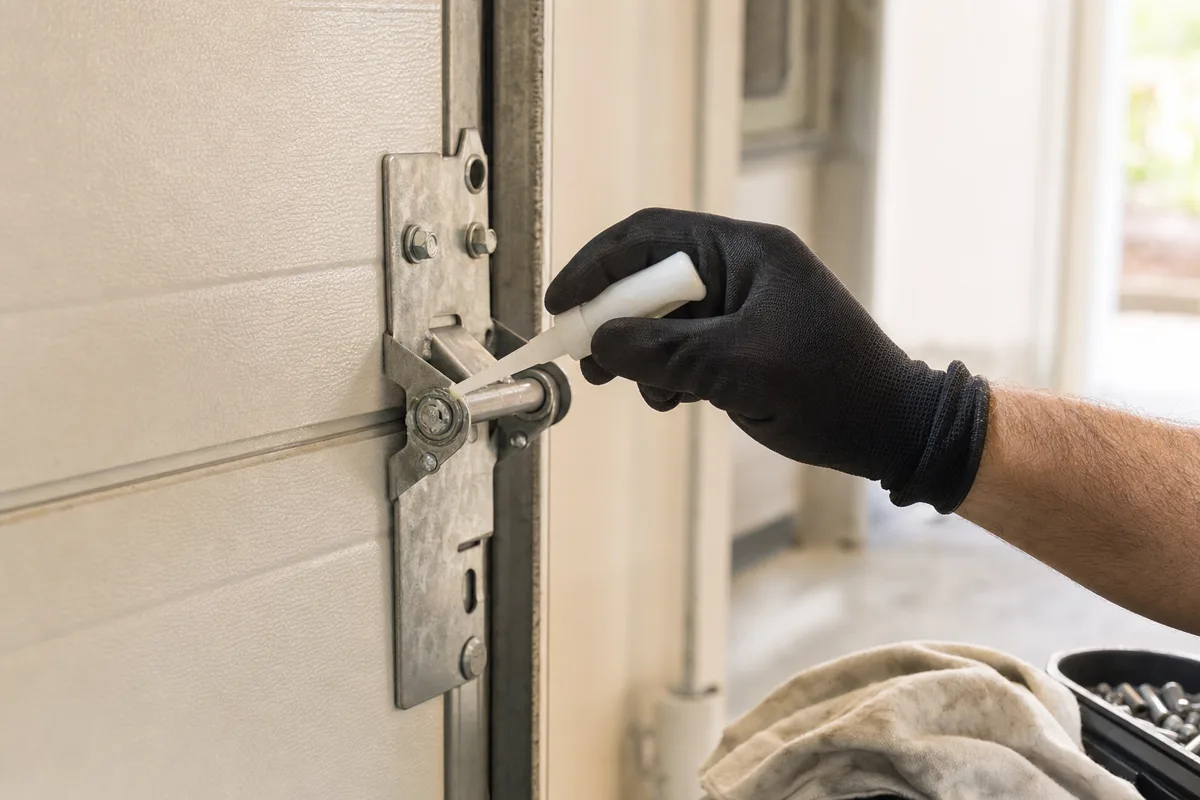
Hinge pins, roller stems, bearings and the spring are lubricated with a garage door lubricant; the track running surface is cleaned rather than oiled. Fasteners are tightened, alignment is corrected and seals are adjusted or replaced where needed.
Travel limits and force are set to the door's actual behaviour, then the photo eye reverse and the contact reverse are both tested and demonstrated. The manual release is checked and shown, because it matters most during a power failure.
Seized rollers, bent rails and derailed sections corrected and re-squared.
View details
Tension, bearings and shaft hardware set right on springs that are still intact.
View details
Diagnosis for openers that hum, stall, reverse or ignore the wall button.
View detailsFill out the form and we'll confirm your appointment by email.
Garage Door Maintenance & Tune-Up is available across every Hamilton neighbourhood inside the area below.
Map data © Google. Pin shows the service area, not a walk-in location — all work is done at your home.

A real callout, not stock imagery.
A sectional door pulled off its tracks, taken down and supported on site so it could be checked and re-hung safely — photographed on the job.