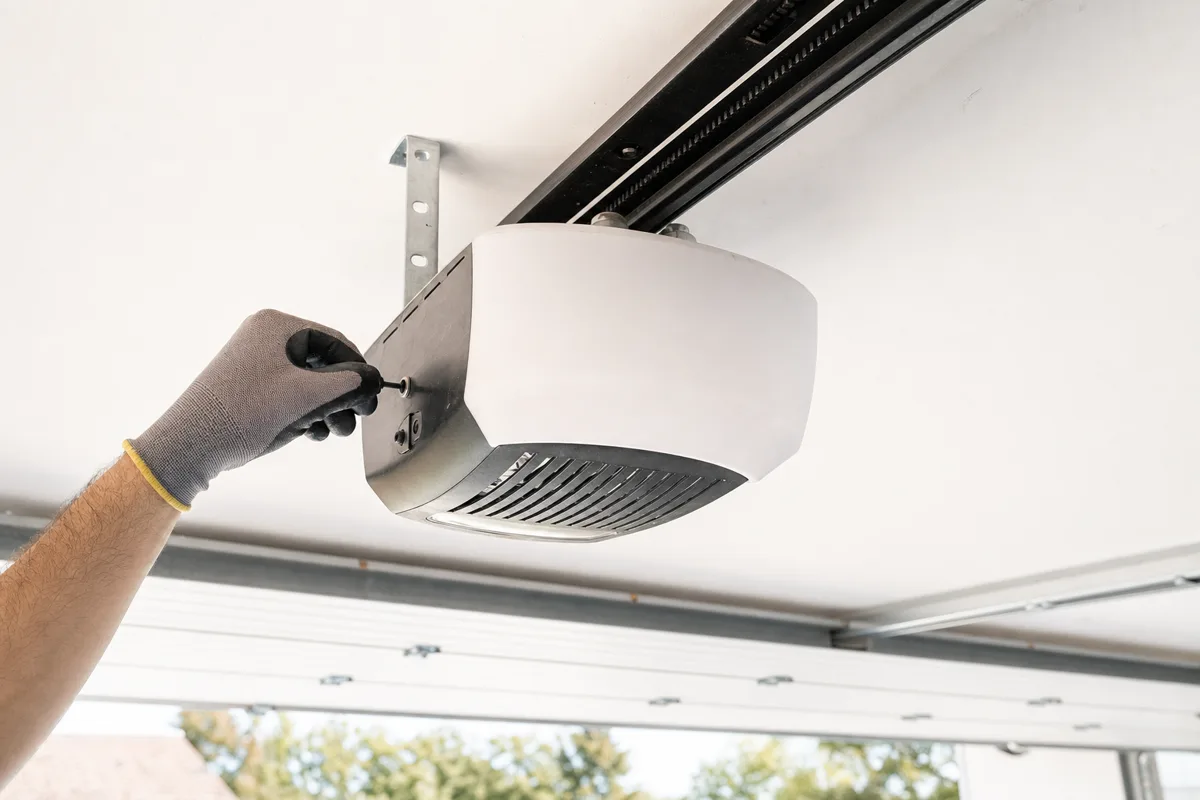

Garage Door Opener Installation
Operators sized to the door, fitted to a balanced system, safety reverse tested.
View detailsDiagnosis for openers that hum, stall, reverse or ignore the wall button.

An opener is a small motor, a drive system, a logic board and a set of safety devices, and each of those fails differently. Diagnosing one properly means separating the opener's problems from the door's, because an operator that strains, reverses or trips is very often reporting a mechanical fault in the door rather than a fault in itself. Repair starts by taking the opener out of the equation and testing the door by hand.
Most residential openers give ten to fifteen years of service, and belt drives often reach the top of that range while running quieter throughout. What shortens the life is an unbalanced door, a poor mounting and a damp, unheated garage. What extends it is an annual door service so the operator is never lifting more than it should, a clean and correctly aligned safety circuit, and keeping the rail and trolley lubricated to the manufacturer's guidance rather than with whatever spray is nearest.
Work through the symptom first — some of these turn out to need no technician at all.
This is the most frequent finding. An opener is sized to overcome friction and start a balanced door moving, not to lift its full weight. A tired or broken spring makes the operator strain, trip its force limit or stall, and no amount of adjustment fixes it. The balance test comes first for exactly this reason.
The safety sensors sit low on each side of the opening, which is where they get knocked, splashed and buried by snow. A blocked, dirty or misaligned eye stops the door closing and usually flashes a code at you. Cabling stapled along a damp jamb is the other common failure in older garages.
Nylon gear sets in chain and screw-drive units wear, sprockets round off, belts stretch and trolley assemblies crack. Grinding with no door movement, or shavings under the opener head, points here. On the Mountain's 1960s and 1970s subdivisions many operators are on their second or third generation and this is normal end-of-life wear.
Logic boards fail, receivers lose programming, capacitors age and remote batteries die. Cold matters too: an unheated garage in a Hamilton January, with a daily mean near minus five degrees, is hard on batteries and on marginal solder joints, so intermittent faults often appear in winter first.
Hamilton's post-war Mountain subdivisions are where opener age shows most. In neighbourhoods where roughly two-thirds of homes were built between 1961 and 1980, the attached garage is original and the opener is usually a later addition, sometimes fastened into a drywalled ceiling with no proper blocking behind it. Newer areas such as the Meadowlands, Sheldon and Waterdown have operators that came with the house and are now reaching normal gear-set and board wear rather than safety obsolescence.
Every opener should reverse when the door meets an obstruction and, on any modern unit, when the photo eye beam is broken. Those two tests are worth doing monthly, and a door that fails either should be taken out of service until it is fixed. Never disable, bypass or raise the photo eyes to stop nuisance reversals; the nuisance is the symptom. Unplug the opener before working near the head, and never adjust force settings to overcome a door that has become heavy.
The manual release is pulled and the door is moved by hand to establish whether the counterbalance and guide path are sound. If the door is heavy or binding, that is diagnosed before anything is done to the operator, because the opener cannot be set up correctly against a faulty door.
Photo eye alignment, lens condition, wiring and the wall control are checked, along with any keypad or receiver. Diagnostic codes on the unit are read where the model provides them, which frequently shortens the search considerably.
Gear set, sprocket, chain or belt tension, trolley, rail alignment and the header and ceiling mountings are examined. A sagging or under-anchored mount causes symptoms that look electrical, particularly on older framing that was never drilled for the current unit.
Where parts are available and the unit is worth keeping, it is repaired and then travel limits and force settings are set to the door's real behaviour. Where the unit lacks working photo eyes or parts are obsolete, replacement is recommended with the reason stated rather than implied.
Operators sized to the door, fitted to a balanced system, safety reverse tested.
View details
Tension, bearings and shaft hardware set right on springs that are still intact.
View details
Balance test, hardware torque, lubrication and a full safety-system check.
View detailsFill out the form and we'll confirm your appointment by email.
Garage Door Opener Repair is available across every Hamilton neighbourhood inside the area below.
Map data © Google. Pin shows the service area, not a walk-in location — all work is done at your home.

A real callout, not stock imagery.
A sectional door pulled off its tracks, taken down and supported on site so it could be checked and re-hung safely — photographed on the job.