
Garage Door Maintenance & Tune-Up
Balance test, hardware torque, lubrication and a full safety-system check.
View detailsSeized rollers, bent rails and derailed sections corrected and re-squared.

The tracks and rollers are the door's guide path, and almost every complaint about noise, sticking or juddering starts there rather than in the opener. Rollers wear, bearings seize, tracks get knocked out of alignment and fasteners loosen in framing that moves with the seasons. Putting the guide path right is often the cheapest improvement available on an otherwise sound door.
Basic steel rollers often need replacing at seven to ten years; sealed nylon rollers commonly last longer and run considerably quieter. Track itself should last the life of the door if it is kept aligned, clean and undamaged, since it is the fasteners and the rollers that wear rather than the steel channel. An annual clean of the track bottoms, a light lubrication of the roller stems and hinges, and a check of the lag bolts will usually double the interval between guide-path repairs.
Work through the symptom first — some of these turn out to need no technician at all.
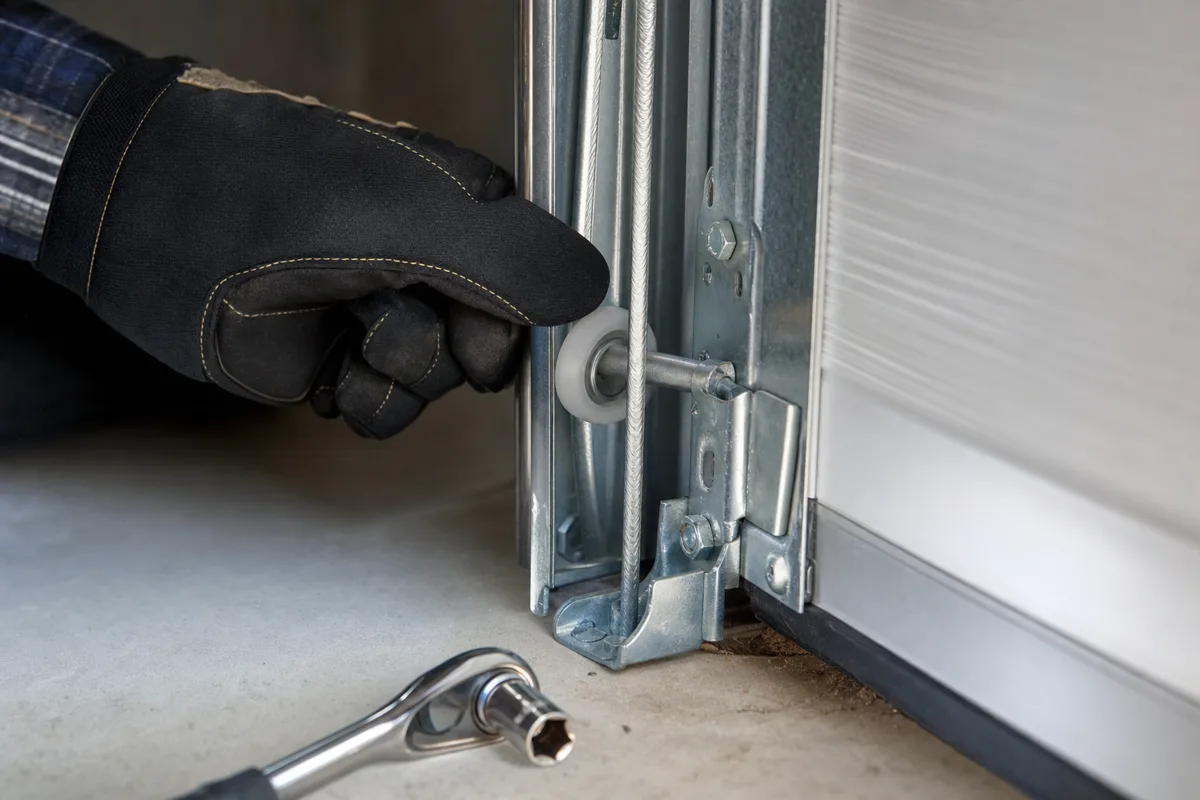
Steel rollers with unsealed bearings are the standard builder fitting and they are the first thing to wear out. Once a bearing seizes, the roller skids along the track instead of rolling, which is loud, wears the track and drags the door against its guide path on every cycle.
Sand from winter road treatment, gravel from unpaved approaches and general garage debris collect in the bottom of the vertical track. That grit acts as an abrasive between the roller and the track, and it is why cleaning the track is part of maintenance rather than housekeeping.
Tracks are fixed to jambs and to the ceiling structure, and both move as wood swells and dries through Hamilton's 66.4 freeze-thaw days a year. Over years, fasteners loosen and the track's spacing from the door changes, so rollers bind at some points and float at others.
A bumper, a bicycle or a snowblower against a vertical track bends it enough to matter. On short driveways and narrow lower-city approaches, including laneway garages reached through lanes only three to four metres wide, low-speed contact is a normal way for tracks to get damaged.
Two Hamilton details land squarely on the guide path. The first is winter grit: with 156.5 centimetres of seasonal snowfall at the airport station, sand and salt get tracked into every garage and settle in the bottom of the vertical track. The second is grade. Escarpment-side streets and the accesses that climb the brow mean many driveways slope, and a sloping approach with a floor line that is not level loads one side of the door more than the other, which shows up as one roller wearing far faster than its partner.
The lowest roller on each side sits in a bracket that is under cable tension, so that bracket is never loosened as part of track work while the door is unsupported. Track fasteners hold a heavy moving assembly to the building, and a door that has come off its track should not be pushed, pulled or run under power to see whether it re-seats itself. Leave a derailed door where it is, keep vehicles and people out of the opening, and have it lifted back into the track properly.
A full cycle under power and then by hand shows where the resistance is. Noise, hesitation and side load usually localise to a specific roller, a specific length of track or the curve where vertical meets horizontal.
Vertical tracks are checked for plumb, horizontals for level and correct back pitch, and the gap between track and door is checked along the whole run. All the fasteners into jamb and ceiling framing are tested rather than assumed.
Seized and worn rollers are replaced, usually as a full set so the door runs consistently. Lightly deformed track can sometimes be straightened; kinked, split or badly dented track is replaced, because a repaired kink keeps snagging.
Hinges, roller stems and bearings are lubricated with a proper garage door lubricant rather than a general spray, alignment is fine-tuned, and the opener force and limits are reset to the reduced friction. Photo eyes and contact reverse are tested last.
Balance test, hardware torque, lubrication and a full safety-system check.
View details
Frayed, slack or unwound lift cables renewed and rewound evenly on both drums.
View details
Fast attention for doors hanging crooked, jammed part-way, or stuck wide open.
View detailsFill out the form and we'll confirm your appointment by email.
Garage Door Roller & Track Repair is available across every Hamilton neighbourhood inside the area below.
Map data © Google. Pin shows the service area, not a walk-in location — all work is done at your home.
A real callout, not stock imagery.
A sectional door pulled off its tracks, taken down and supported on site so it could be checked and re-hung safely — photographed on the job.